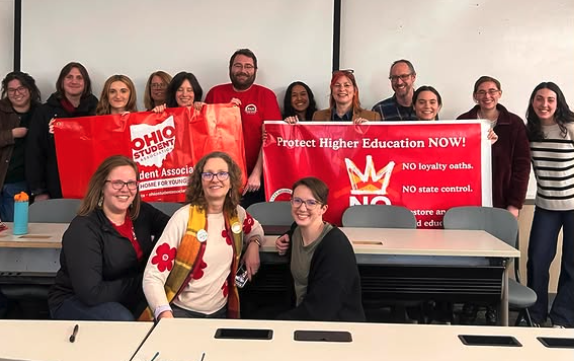
Pixie delivered this speech at the FAM+OSA Public Town Hall on Feb 6, 2026.
Hey guys! For those of you who don’t know me, my name is Pixie Menezes. I am an undergraduate senior studying organizational leadership and sociology. I am also the statewide communications director for the College Democrats of Ohio.
INFORM
When we talk about the state of education and democracy, what we’re really talking about is power—
who has it, who doesn’t, and who pays the price when decisions are made behind closed doors.
I want to start by naming the position from which I’m speaking from. I am an affluent young first generation Indian woman, who is pansexual, disabled, and a survivor of sexual violence on campus.
I come to this work from lived experience at the intersections of race, gender, disability, sexuality, class, and survival within institutions that were not designed with people like me in mind.
Living at these intersections has taught me that the people most impacted by injustice are almost always the last ones asked how systems should change.
This pattern isn’t new. In fact, we lowkey saw it at our protest last week, when there were rarely any people of color given the opportunity to speak.
In 1964, we also saw this pattern during Freedom Summer, when students and community members organized together to challenge Black voter suppression and race based violence in Mississippi.
What made Freedom Summer powerful wasn’t just courage—it was the commitment to active listening. White student organizers from the North didn’t lead by imposing solutions.
They followed the leadership of Black Mississippians who understood, through lived experience, exactly what the absence of democracy looked like.
Freedom Summer showed us that democracy is not granted from the top down. It’s built from the ground up—when people closest to the harm are centered in the fight for change.
AGITATE
Today, the state of higher ed and many other institutions are facing their own crisis of democracy.
Students are told to take on crushing debt for a future that feels increasingly unstable. I started applying to jobs in August. At this point I have applied to 550 jobs, had 23 interviews, and yet, no job is offering a liveable wage.
Faculty and staff are asked to do more with less while their working conditions continue to erode.
Graduate workers who keep classrooms running without job security earn little pay.
Custodial and dining hall workers sustaining campus life remain invisible to those in power. And communities, like the townies of Oxford, are shut out of decisions made by institutions, like Miami University, that claim to serve the public good.
This atomization isn’t accidental.
It’s the result of a system that treats higher education like a business rather than a public trust.
Academic freedom isn’t just about our professors—
It’s about whether students are allowed to learn the full truth of our history, our politics, and our world. When curricula are censored and dissent is punished, education stops being education and becomes compliance training.
Diversity and equity on campus should be more than a buzzword or branding strategy because it is what makes learning honest and rigorous.
If students, especially those who are marginalized, cannot access education safely, fully, and with dignity, then the institution is failing its mission.
We cannot trust processes that were never designed to protect us. Disruption is fundamental to a working democracy that truly serves the people.
When we silence or ignore those with lived experience, we don’t just fail marginalized people. We weaken the quality of education entirely.
Because universities cannot claim to pursue truth while ignoring the voices of those most affected by injustice.
This affects every single person here, not just those that sit at the margins like myself.
When labor rights are attacked, academic freedom suffers. When campuses are underfunded, both students and workers both pay the cost. When any one group is isolated, all of us are made weaker.
Despite our different identities, our struggles are not separate. They are deeply interconnected.
ASK
So now what do we do with that knowledge?
Well first, we listen—really listen—to those most impacted. Not defensively. Not selectively. But with the understanding that lived experience is expertise in its own right.
Second, we act in solidarity. Freedom Summer teaches us that change happens when people organize across differences—across job titles, departments, identities, and communities. Wall-to-wall solidarity is not a catchy slogan; it is a strategy.
Third, we demand more.
We demand fully funded public higher education.
We demand fair pay and dignified working conditions for everyone who makes our campuses run.
We demand protection for migrant, immigrant, and international students and workers.
We demand the freedom to teach, to learn, to dissent, and to organize without fear.
And finally, we continue to show up for each other.
Because democracy is not sustained by institutions alone– It’s sustained by people who refuse to accept exclusion, exploitation, and silence as the new normal.
Freedom Summer reminds us that ordinary people like us—students, workers, community members—have always been the ones to expand democracy and civil rights.
What we’re building here is bigger than defending what we have. It’s about demanding what we deserve:
a higher education system that serves democracy, not donors;
a future where learning is liberating, work is dignified, and institutions are accountable to the people they claim to serve.
And this is long overdue.
Leave a Reply